

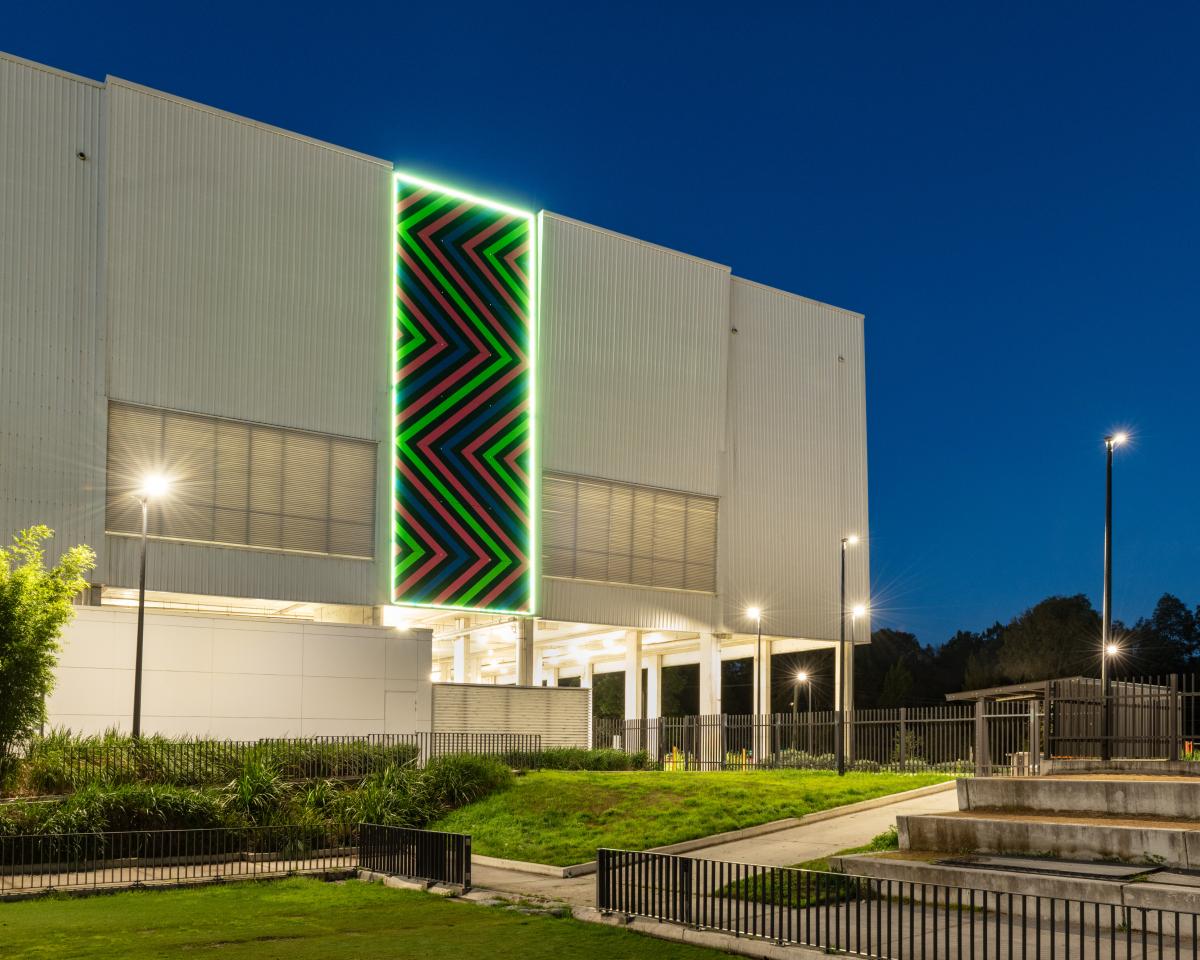
Regalia
Reko Rennie, 2020
This work references the pictographic language of mark-making on wooden surfaces seen in shields, boomerangs, and woomeras — a visual language carved into wooden accoutrements and weapons, which connected many of the east coast Aboriginal language groups to the songlines that linked all Aboriginal nations across Australia. The artwork combines the traditional symbolism of chevrons with contemporary references to V Neck rugby league jerseys in bright metallic colours. The transposition of traditional Aboriginal iconography into a contemporary context of teams competing on the football field is achieved by using bright metallic colours, neon lighting, and seeks to make the Aboriginal heritage of the Concord Oval site visible.
About the artist: Reko Rennie
Reko Rennie is a prominent Australian artist known for his vibrant and thought-provoking works that explore Indigenous identity and challenge stereotypes. Born in 1974 and raised in Melbourne, Rennie is a Kamilaroi/Gamilaraay/Gummaroi man who brings his unique perspective to contemporary art. His artistic journey began with graffiti in his youth, which has significantly influenced his style. His signature aesthetic involves bold geometric patterns, often in fluorescent colours, operating as counter narrative to the stereotypical and appropriated representations of Aboriginal art created by non-Indigenous artists in the mid-20th century. His artworks combine the iconography of his Kamilaroi heritage with stylistic elements of graffiti. Reko is recognised for his significant contributions to Australian art and his ongoing advocacy for Indigenous rights and representation, and his work has been exhibited nationally and internationally.
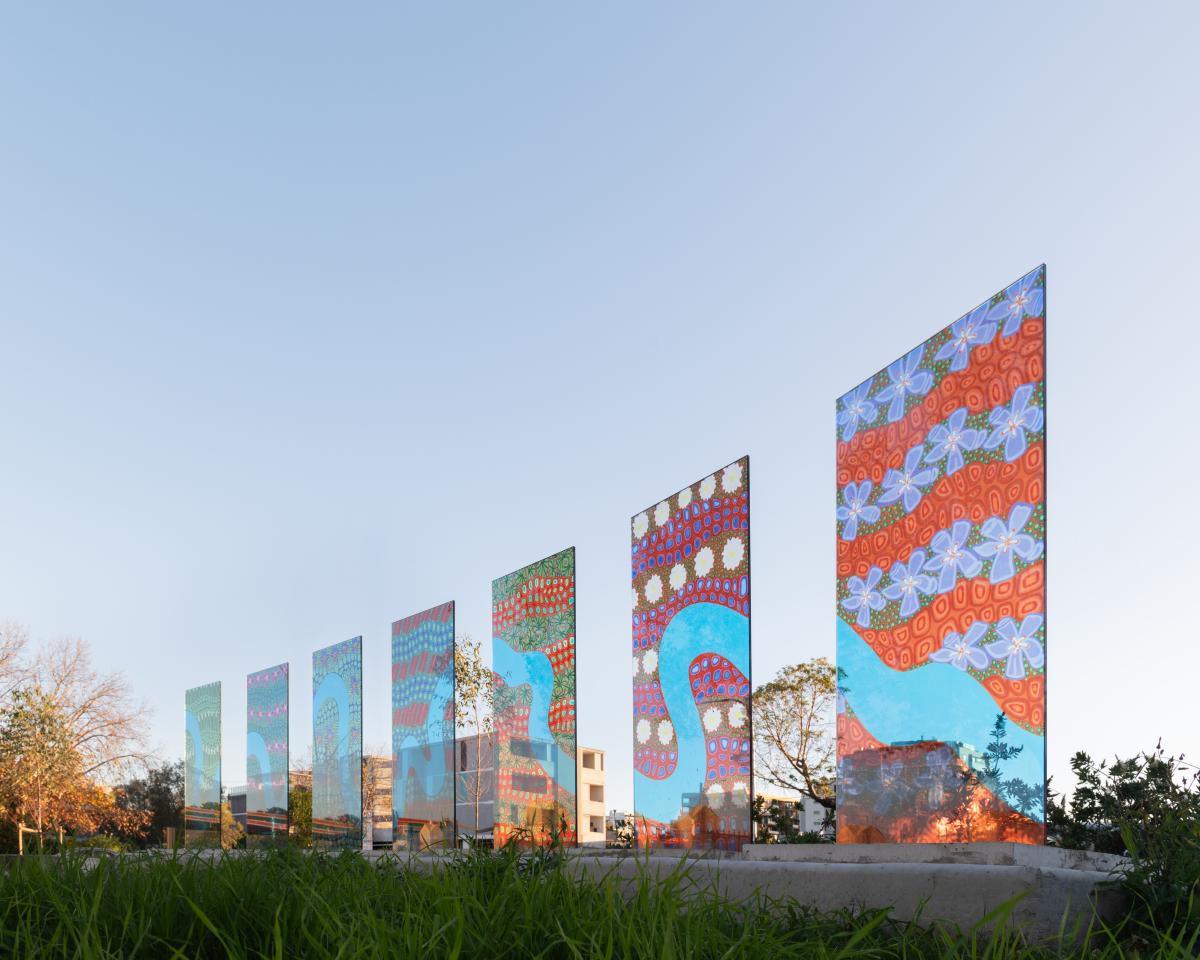
The Beauty in Remembering
Dr. Bronwyn Bancroft AM, 2025
This artwork honours the past and shows respect to the Wangal people, the first inhabitants and traditional custodians of this area. The design was created in response to the local landscape and the natural waterways that would have existed on this site prior to colonisation. This artwork consists of a series of seven glass panels each depicting a different native plant from the local area. The artwork speaks to the vibrancy and regeneration of nature, as well as remembrance and reflection of what was here before.
About the artist: Bronwyn Bancroft AM
Dr. Bronwyn Bancroft AM is a Bundjalung woman and artist. Her professional career as an artist began following her graduation from the Canberra School of Arts in 1980. Bronwyn’s career has included both national and international exhibitions. Her work has been acquired by major Australian galleries, state libraries and private collections. Bronwyn’s contribution to Indigenous literature has been immense and has included the publication of over 47 children’s books. Bronwyn has been commissioned for numerous public artworks including Leichhardt Park Aquatic Centre, Central Station, Tempe Reserve and Royal North Shore Hospital. Bronwyn was appointed a Member of the Order of Australia in 2024 for her significant service to the arts and to the Indigenous community.
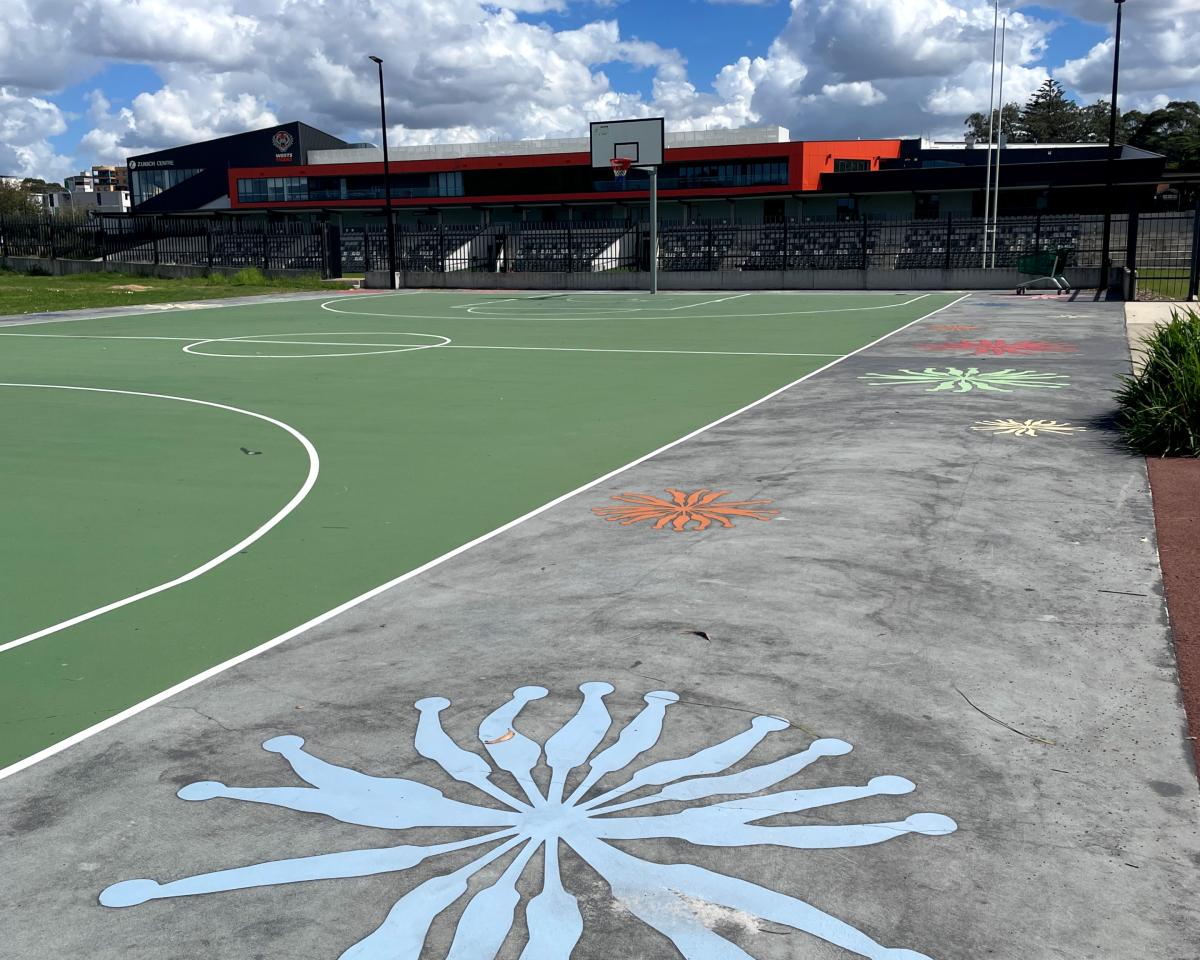
Memory Shadows
Maddison Gibbs, 2025
Memory Shadows honours Aboriginal ancestors and cultural practices. All technology is derived from fire. All technology has been developed from people gathering around the fire conversing.
The fire wheel symbol is a graphic interpretation of connected people radiating from a central fire. The fire is central and the people represent both Aboriginal people in Australia and non-Aboriginal people overseas.
The circular shape represents both Australia and the world. The Circle also refers to the stone wheel, which also was a significant technological advancement.
Whilst the work has specific links to Australia it can be read in an inclusive international context and with wide understanding. Technology only advances when it is collectively shared.
The spirit/human figures are gender neutral and culturally inclusive. This also speaks to an international solidarity to Indigenous minority groups worldwide.
The fire wheel image represents a campfire, waterhole, stars, meeting place, spirits, people and more.
The illuminated stars element speak to the complex astrological knowledge understood by both Aboriginal and non-Aboriginal people. The stars remember. This is a subtle reflection point where people can find an instant visual calm. As you often do not see stars in a city scape.
The fire wheels are the stars and the constellations that hold knowledge. They mark when food is ready when seasons are changing. The fire wheels glisten and shimmer as they reflect and capture stories and cultural knowledge.
About the artist: Maddison Gibbs
Maddison Gibbs is a proud Barkindji woman who grew up in Dubbo and currently lives and works between Sydney and Kandos. A multidisciplinary artist and activist, her work focuses on stories of past and present Aboriginal societies and spirit. A multidisciplinary artist, Maddison works across a wide spectrum of cultural praxis, utilising many methods and ideologies.